
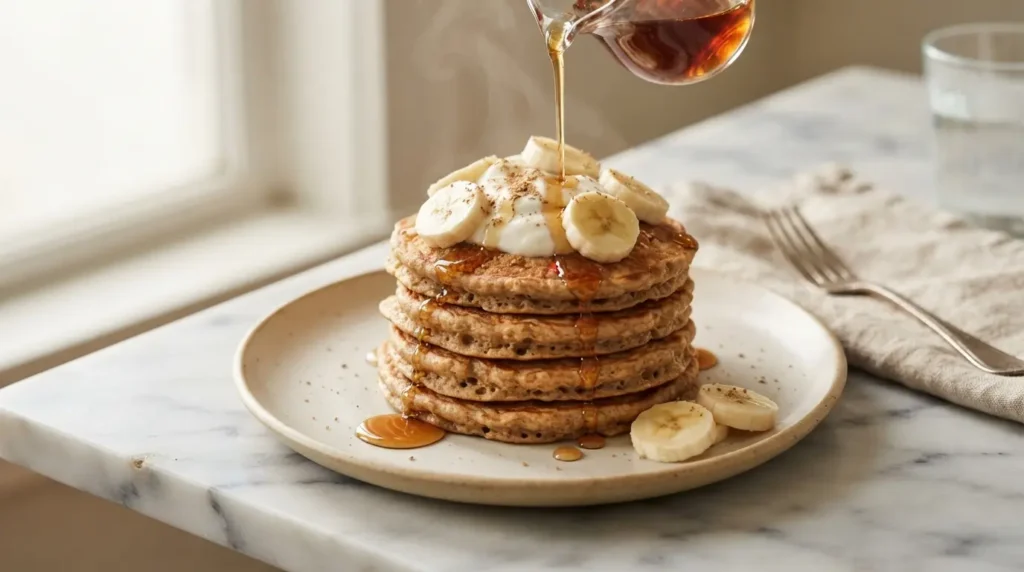
I used to think “high fiber breakfast” meant a bowl of something beige that tasted like a cardboard box. Then I spent a winter trying to fix a digestion situation that had gotten genuinely annoying – the bloating, the unpredictability, the 10 a.m. hunger crash – and my dietitian said something that stuck: stop trying to overhaul everything, and just make one meal a day do more work.
Breakfast was the obvious candidate. And after a lot of gluey, sad, falls-apart-in-the-pan attempts, these are the pancakes that stuck.
They’re made in a blender, they take about 25 minutes start to finish, and each serving delivers around 8 grams of fiber – roughly a third of the 25 grams most women need in a day. They also don’t taste healthy, which is the whole point. My husband eats them without knowing there’s flaxseed in there, and I’d like to keep it that way.
Quick Answer
High fiber banana oat pancakes are blender pancakes made from whole rolled oats, ripe banana, eggs and ground flaxseed instead of refined white flour. One serving of this recipe (four 3-inch pancakes) provides about 8 grams of dietary fiber, 16 grams of protein and 355 calories. The oats supply beta-glucan, a soluble fiber that ferments in the large intestine; the flaxseed adds insoluble fiber for bulk; and the banana contributes both pectin and – if it’s still slightly green – resistant starch that feeds beneficial gut bacteria.
Total time: 25 minutes. Makes 8 pancakes (2 servings).
Why These Pancakes Earned a Permanent Spot in My Week
- They actually hit a meaningful fiber number. Most “healthy” pancakes land around 3 grams. These land around 8, and 10 if you add the chia.
- One blender, one bowl to wash. No flour, no sifting, no measuring six dry ingredients.
- They freeze beautifully. I make a double batch on Sunday and toast them straight from frozen on weekday mornings.
- No refined flour and no added sugar required. The banana does the sweetening.
- They keep me full until lunch. This is the fiber and the 16 grams of protein working together, not magic.
- Kid-approved and picky-partner-approved. Nobody has ever asked me what’s in them.
- Naturally gluten-free when you use certified gluten-free oats.
What Makes These Different From Every Other Banana Oat Pancake
There are a thousand three-ingredient banana oat pancake recipes on the internet. Most of them are fine. But they share two problems, and fixing both is what took me from “these are okay” to “these are the ones.”
The fiber math, actually written out
Almost no recipe tells you where the fiber is coming from. So here it is, per full batch:
| Ingredient | Amount | Fiber |
|---|---|---|
| Rolled oats | 1 cup (90 g) | ~9.1 g |
| Ground flaxseed | 2 tbsp (14 g) | ~3.8 g |
| Ripe banana | 1 medium (118 g) | ~3.1 g |
| Batch total | ~16 g | |
| Per serving (½ batch) | ~8 g | |
| With optional chia | 1 tbsp (12 g) | ~10 g per serving |
Three basic banana-egg-oat pancakes get you maybe 4 grams. The flaxseed is doing quiet, important work here.
Banana ripeness changes what your gut gets
This is the part nobody talks about, and it genuinely changed how I make them.
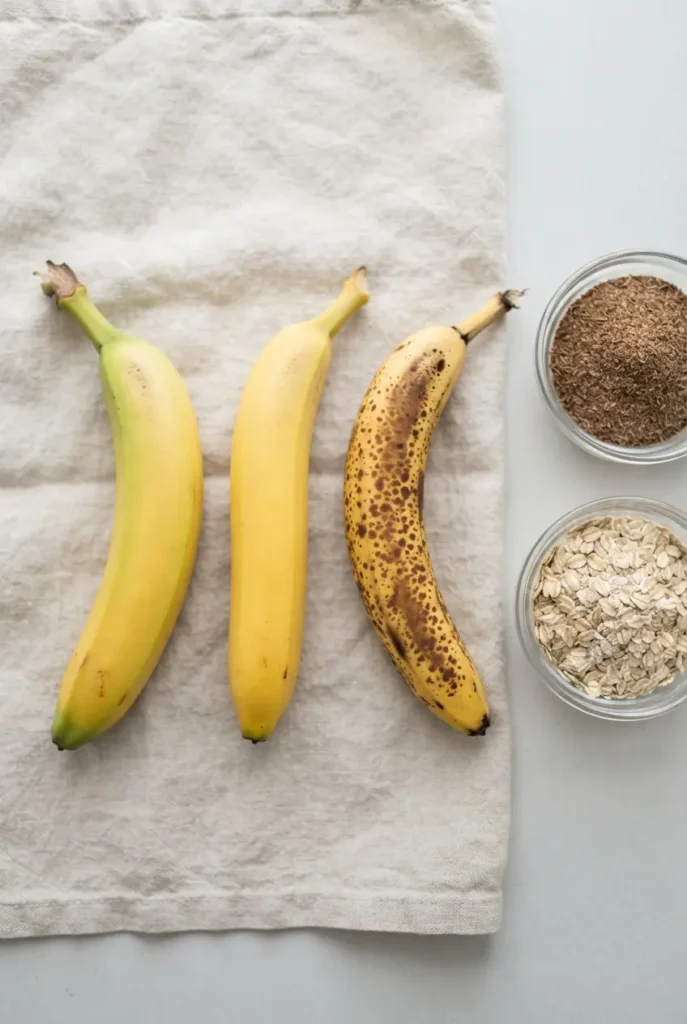
An underripe, still-slightly-green banana is high in resistant starch – a starch that escapes digestion in the small intestine and gets fermented by bacteria in the colon, behaving much like a prebiotic fiber. As the banana ripens, enzymes convert that resistant starch into simple sugars. That’s why a spotty banana tastes sweet: the prebiotic starch has literally turned into sugar.
So there’s a trade-off, and you get to choose:
| Banana stage | Sweetness | Gut benefit | Best for |
|---|---|---|---|
| Yellow with green tips | Low | Highest resistant starch | Prebiotic focus; add 1 tsp maple syrup |
| Fully yellow | Medium | Balanced | The everyday default |
| Heavily spotted / brown | High | Lowest resistant starch, most natural sugar | Kids, no-syrup mornings, dessert-style |
I use a fully yellow banana with a few green tips on weekdays and a spotty one when I want them to taste like dessert. Both work. They just work differently.
Ingredients
Makes 8 pancakes · 2 generous servings
- 1 cup (90 g) old-fashioned rolled oats – certified gluten-free if needed
- 2 tbsp (14 g) ground flaxseed
- 1 medium ripe banana (about 118 g, peeled)
- 2 large eggs
- ½ cup (120 g) plain kefir or plain Greek yogurt
- 1 tsp baking powder
- ½ tsp ground cinnamon
- ¼ tsp fine sea salt
- 1 tsp vanilla extract
- 2–4 tbsp milk of choice, to thin
- 1 tbsp chia seeds (optional, for ~10 g fiber per serving)
- Butter, coconut oil or avocado oil, for the pan
Ingredient Notes
Rolled oats, not instant. Old-fashioned rolled oats blend into a flour with a little texture and hold structure in the pan. Instant oats are pre-cut and pre-steamed; they turn to paste and give you a gummy center. Steel-cut oats won’t blend fine enough – don’t try it.
Ground flaxseed, not whole. Whole flaxseeds pass through you essentially intact. Grinding is what makes the fiber and the omega-3s available. Buy it pre-ground and keep it in the freezer, because the oils go rancid fast at room temperature.
Kefir or Greek yogurt. Kefir is my first choice because it carries live cultures and a wider range of them than most yogurts. Yes, cooking heat will kill most of those cultures – I’m not going to pretend otherwise. What kefir reliably does here is give you tang, tenderness (the acid reacts with the baking powder for lift), and extra protein. If you want live cultures actually intact, spoon cold kefir or yogurt on top at the end. That’s the move.
Baking powder. Oat batters are heavy. Without a full teaspoon you get dense discs. Check that yours is fresh – drop ¼ tsp in hot water; if it doesn’t fizz enthusiastically, replace it.
Eggs. They’re the structural binder. Oat flour has no gluten, so the eggs are the only thing holding these together.
Salt. A quarter teaspoon sounds trivial. Leave it out and the pancakes taste flat and vaguely raw. Don’t skip it.
Ingredient Substitutions
| Ingredient | Swap | Notes |
|---|---|---|
| Rolled oats | 1 cup (90 g) oat flour | Skip the blending step entirely |
| Eggs | 2 flax eggs (2 tbsp ground flax + 5 tbsp water, rested 10 min) | Adds ~4 g fiber; pancakes will be more delicate — make them smaller |
| Kefir | Greek yogurt, coconut yogurt, or buttermilk | Coconut yogurt is thinner; use less milk |
| Banana | ½ cup unsweetened applesauce or ½ cup pumpkin purée | Add 1 tsp maple syrup; you’ll lose the resistant starch |
| Ground flaxseed | Ground chia or 2 tbsp psyllium husk (use only 1 tbsp psyllium) | Psyllium absorbs a lot of liquid — add extra milk |
| Milk | Any dairy or plant milk | Oat milk makes them a touch sweeter |
| Cinnamon | Cardamom, pumpkin pie spice, or nutmeg | Cardamom is genuinely excellent here |
Kitchen Tools You’ll Need
- A blender – a standard countertop blender is fine; a high-speed one gives smoother flour. No blender? Use oat flour and whisk everything in a bowl.
- A nonstick or well-seasoned cast iron skillet – cast iron gives better browning, nonstick gives easier flipping. Both work.
- A thin, flexible spatula – a thick spatula tears oat pancakes. This matters more than you’d think.
- A ¼-cup measure or cookie scoop – for even sizing and even cooking.
- A wire cooling rack – stacking hot pancakes on a plate steams the bottoms soggy.
How to Make High Fiber Banana Oat Pancakes
Prep: 5 minutes · Rest: 10 minutes · Cook: 12 minutes · Total: 25 minutes
- Blend the oats into flour. Add the rolled oats to a dry blender and blend on high for 30–45 seconds, until they look like a coarse flour. Stop before it turns to powder – a little texture is good.
- Add everything else. Drop in the banana, eggs, kefir, flaxseed, baking powder, cinnamon, salt and vanilla. Blend for 20–30 seconds, scraping down the sides once, until just smooth. Don’t over-blend; you’re not making a smoothie.
- Rest the batter for 10 minutes. This is the step everyone skips and the reason most oat pancakes come out gummy. The oat flour and flaxseed need time to absorb liquid and swell. Skip it and the batter keeps thickening in the pan while the outside cooks, which is exactly how you get a raw-tasting center. Stir in the chia now if you’re using it.
- Check the consistency. After resting, the batter should ribbon off a spoon slowly — thicker than crepe batter, looser than muffin batter. Thin with milk, one tablespoon at a time, until it does.
- Heat the pan properly. Medium-low heat. Lightly grease. Wait until a drop of water sizzles gently rather than skittering violently — oat pancakes need a lower, slower heat than flour pancakes because the natural sugars in banana brown fast.
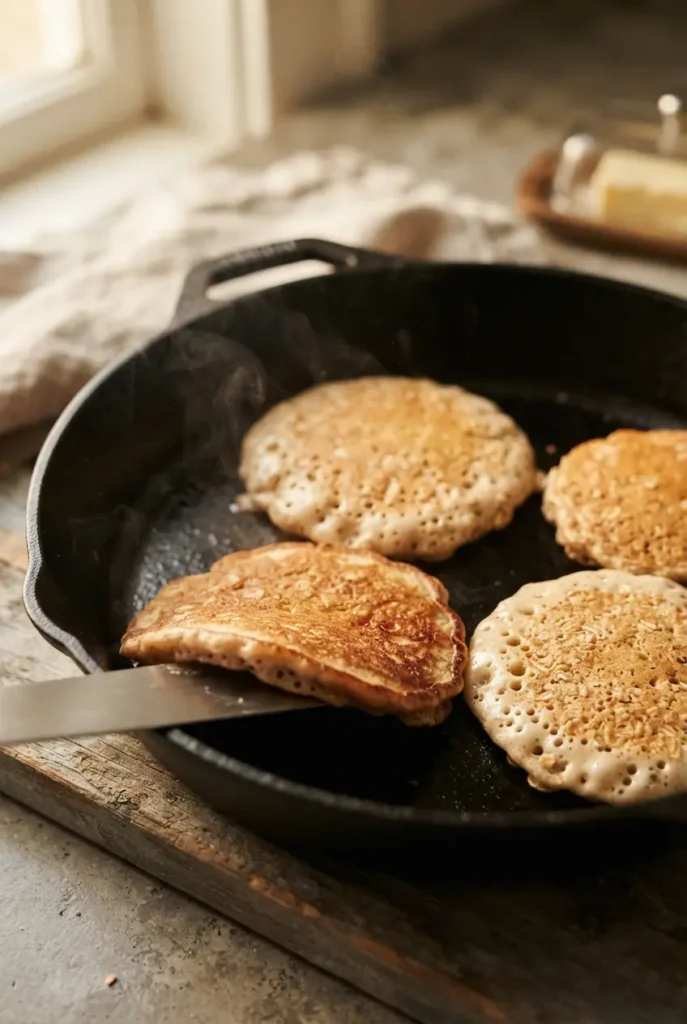
- Cook the pancakes. Pour ¼-cup portions, spreading each slightly with the back of the spoon. Cook 2½–3 minutes on the first side. Wait for bubbles to form and for the edges to look matte and set. Oat pancakes don’t bubble as dramatically as flour pancakes, so use the edges as your real signal.
- Flip once and finish. Slide your thin spatula fully under before flipping. Cook another 1½–2 minutes until golden. Flip once only — repeated flipping deflates them.
- Rest on a rack and serve. Transfer to a wire rack, not a plate, while you cook the rest. Serve warm with a spoonful of cold kefir or yogurt, fresh berries, and a small drizzle of maple syrup.
Expert Tips From Making These Roughly 200 Times
Make them smaller than you think. Three-inch pancakes flip cleanly. Six-inch pancakes tear in the middle and break your spirit. Oat batter has no gluten network to hold a large pancake together.
Medium-low, always. If your first pancake is dark outside and wet inside, your heat is too high. Turn it down and accept that pancake as the sacrificial test pancake. There is always a test pancake.
Double the batch and freeze half. The prep cost is identical and Tuesday-morning you will be grateful.
Grease between batches, lightly. A folded paper towel with a little oil, wiped across the pan, is better than adding fresh butter each round — which burns and makes the later pancakes taste bitter.
Add the toppings cold. Cold kefir or yogurt on a warm pancake is a genuinely better texture experience than syrup alone, and it’s where your live cultures survive.
Weigh the oats if you can. One cup of oats can vary by 15 grams depending on how you scoop, and that’s the difference between fluffy and dense.
5 Mistakes That Ruin Oat Pancakes
| Mistake | What happens | The fix |
|---|---|---|
| Skipping the 10-minute rest | Gummy, raw-tasting centers | Rest the batter. Every time. |
| Heat too high | Dark outside, wet inside | Medium-low, and be patient |
| Pancakes too large | They tear when flipped | ¼-cup portions, 3 inches wide |
| Flipping too early or too often | Dense, flat, deflated | One flip, once the edges go matte |
| Using instant oats | Paste-like texture | Old-fashioned rolled oats only |
Recipe Variations
Blueberry Flax — Fold ½ cup fresh blueberries into the rested batter by hand. Adds about 2 g fiber and a lot of antioxidants. Don’t blend them in unless you want grey pancakes.
Chocolate Chia — Add 2 tbsp unsweetened cocoa powder, 1 tbsp maple syrup and the optional chia. Tastes like dessert, still hits 10 g fiber.
Apple Cinnamon — Swap half the banana for ¼ cup unsweetened applesauce and bump cinnamon to 1 tsp. Cozier, slightly less sweet.
Pumpkin Spice — Replace the banana with ⅓ cup pumpkin purée, add 1 tsp pumpkin pie spice and 1 tbsp maple syrup. Fall in a pan.
Extra Protein (24 g per serving) — Add one scoop (30 g) of unflavored or vanilla protein powder plus 3 extra tbsp milk. The batter tightens considerably, so thin it more than feels right.
Savory Herb — Skip the banana, cinnamon and vanilla. Add 2 tbsp nutritional yeast, 2 chopped scallions and black pepper. Top with a fried egg. Unexpected and very good.
Dairy-Free — Coconut yogurt plus almond milk. Works exactly as well.
What to Serve With Them
For maximum fiber: raspberries (8 g per cup — the highest-fiber common berry), sliced pear with the skin on, or a spoonful of chia jam.
For staying power: a tablespoon of almond or peanut butter, or cottage cheese instead of yogurt.
For a full brunch: soft-scrambled eggs, sliced avocado, and a pot of ginger tea.
For gut support: cold kefir, a spoonful of plain live-culture yogurt, or a sprinkle of hemp hearts.
Skip: flavored syrups and fat-free flavored yogurts. They’re sugar-delivery systems and they undo the point of the meal.
Storage, Freezing and Reheating
Refrigerator
Cool completely on a wire rack, then store in an airtight container for up to 4 days. Cooling completely first is non-negotiable — trapped steam makes them soggy overnight.
Freezer
Freeze in a single layer on a parchment-lined tray for 1 hour, then transfer to a freezer bag with parchment between layers. Keeps for up to 3 months. Squeeze the air out; oat pancakes pick up freezer burn quickly.
Reheating Guide
| Method | Time | Result |
|---|---|---|
| Toaster (from frozen) | 2 cycles on medium | Best. Crisp edges, soft center |
| Air fryer | 350°F / 175°C, 3–4 min | Very good, slightly drier |
| Skillet | Medium-low, 1–2 min per side | Good, needs a little butter |
| Oven | 350°F / 175°C, 8–10 min | Good for large batches |
| Microwave | 30–45 seconds | Fastest, but soft and slightly rubbery |
Do not thaw before reheating. Straight from frozen is better every time.
Nutrition Information
Per serving (4 pancakes, ½ of recipe), without toppings:
| Nutrient | Amount |
|---|---|
| Calories | ~355 |
| Protein | ~16 g |
| Carbohydrates | ~45 g |
| Dietary Fiber | ~8 g |
| Sugars | ~11 g (naturally occurring) |
| Fat | ~11 g |
| Saturated Fat | ~3 g |
| Sodium | ~400 mg |
| Calcium | ~20% DV |
| Iron | ~15% DV |
Values are estimates calculated from standard USDA food composition data and will vary with brands, banana size and toppings. With the optional chia seeds, fiber rises to about 10 g and calories to about 385.
A Note on Adding Fiber Gently
If you’re currently eating around 10–15 grams of fiber a day and you jump to 30 overnight, you will probably feel bloated and gassy — and then conclude that fiber doesn’t agree with you. It does. Your gut bacteria just need time to adjust to the new supply.
Increase gradually over two to three weeks, and drink more water as you do. Soluble fiber like the beta-glucan in oats works by absorbing water and forming a gel; without enough fluid, it can make constipation worse rather than better. A large glass of water with breakfast is part of this recipe, not an afterthought.
If you have IBS, a diagnosed digestive condition, or you’re following a low-FODMAP protocol, talk to your doctor or a registered dietitian before making changes — bananas, oats and flaxseed are tolerated differently by different people, and portion size matters a great deal. This article is general food information, not medical advice.